Education and Regulation, Key to Expanding Fintech and Digital Asset Activity in The Bahamas, Says Expert Panel
16th March 2026
Nassau, THE BAHAMAS – A panel of Financial Technology (fintech) and regulatory experts at the recent Central Banking Summit hosted by University of The Bahamas and the Global Interdependence Center, examined how The Bahamas could expand equitable banking services across the archipelago while embracing digital financial innovation.
The discussion explored both the challenges and innovations of ensuring residents of even the most remote islands and settlements can access full financial services. It also traced the genesis of fintech’s rise in The Bahamas, and how the country responded with innovative regulatory frameworks.
The panel on “Fintech & Digital Assets” offered key insights.
“Innovation by definition means that it is new. It means that if you measure it by the metrics of what exists, it will fail,” said Mr. Keith Davies, CEO of the Bahamas International Securities Exchange (BISX). “Therefore, there should be no reason why we should not continue to push forward, even when you’re told ‘that doesn’t make sense, it doesn’t fit in the box’. It’s not in the box and that’s the point.”
The country’s regulators were carefully monitoring the rapid emergence of new financial technologies and determined that The Bahamas would neither be left behind nor be under-regulated. Legislation was then crafted.
“What we saw is that there was a danger that The Bahamas, being an international financial centre, could be exposed to entities coming into the jurisdiction and setting up shop, without The Bahamas having a definitive position on its approach to digital assets and crypto. That would have been a serious problem for us,” Christina Rolle, Executive Director of the Securities Commission of The Bahamas, said.
Rolle led the development of the Digital Assets and Registered Exchanges (DARE) Act.
She explained that The Bahamas had three choices: do nothing, ban everything, or develop a regulatory framework. The latter became the strategic response.
“The U.S. was taking an approach that everything was going to be put into the category of crypto. We weren’t very confident that that approach could stand up in court, and so we developed the Digital Assets and Registered Exchanges Act because the Act itself defines what a digital asset is.”
That definition, created within the context of the Bahamian jurisdiction, positioned the country among the pioneers recognizing that digital assets require their own regulatory category.
Davies, lent his expertise not only as a regulator but a digital asset creator. He is a founder of Kanoo, a digital wallet platform in The Bahamas.
“What fintech does is allow and bring persons into the financial system. One of the things we do in our organization, Kanoo, is find ways to include people. We have introduced entities, individuals and businesses to the bank that they would never have seen,” he explained.
Beyond stressing the need for traditional and non-traditional banks to become more assertive in expanding access to services, the panel pointed to a more foundational issue: more consistent education is essential. The Central Bank of The Bahamas suggests that roughly 18 percent of the population remains outside the formal banking system.
“The most prominent issue is education and the lack thereof. What stems from that is fear and the possible spread of misinformation,” said Vice President, Digital Assets and Fintech Operations, Liongate Bahamas Ltd. Michael Clare. “If I’m an individual who fears utilizing something that’s new and innovative, that’s mostly stemming from the fact that I know nothing about it. This leads to those very people spreading their personal opinions and fears to those by whom they are trusted, and now that leads to misinformation spreading on a larger scale.”
Clare proposed a stronger marketing and public education campaign that would allow the knowledge and insights shared in the room to reach the wider public.
“I strongly believe we need to implement structures that would teach fintech, digital wallet technologies, digital assets and digital currencies within our current educational systems and even within our judicial frameworks” he said. “If we start from a younger age, we can build confidence and spark interest among younger generations.
“To prepare our country, we need to start at the foundational levels — developing curricula that include financial technology, digital assets, artificial intelligence and related innovations, and allow that knowledge to grow from there.”
The panelists noted that it was also encouraging to see that effort already beginning. Among the attendees at the summit were special guests from Government High School, a group of students invited to observe the discussions, participate in the day’s activities and engage with industry professionals.
-
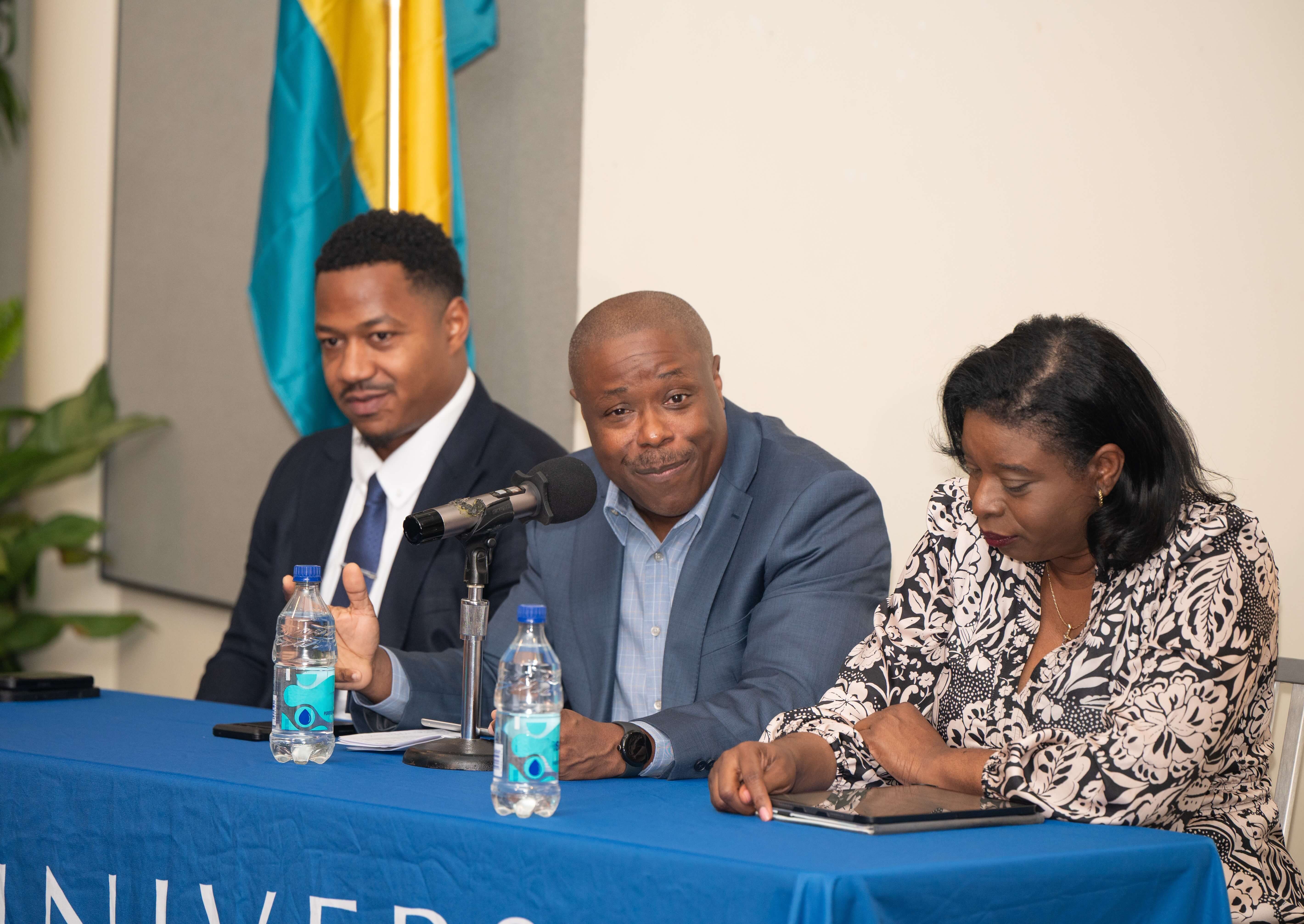
- Panellists at the Central Banking Summit held recently at University of The Bahamas. From left are: Vice President, Digital Assets and Fintech Operations, Liongate Bahamas Ltd. Michael Clare, Mr. Keith Davies, CEO of the Bahamas International Securities Exchange, and Christina Rolle, Executive Director of the Securities Commission of The Bahamas.
-
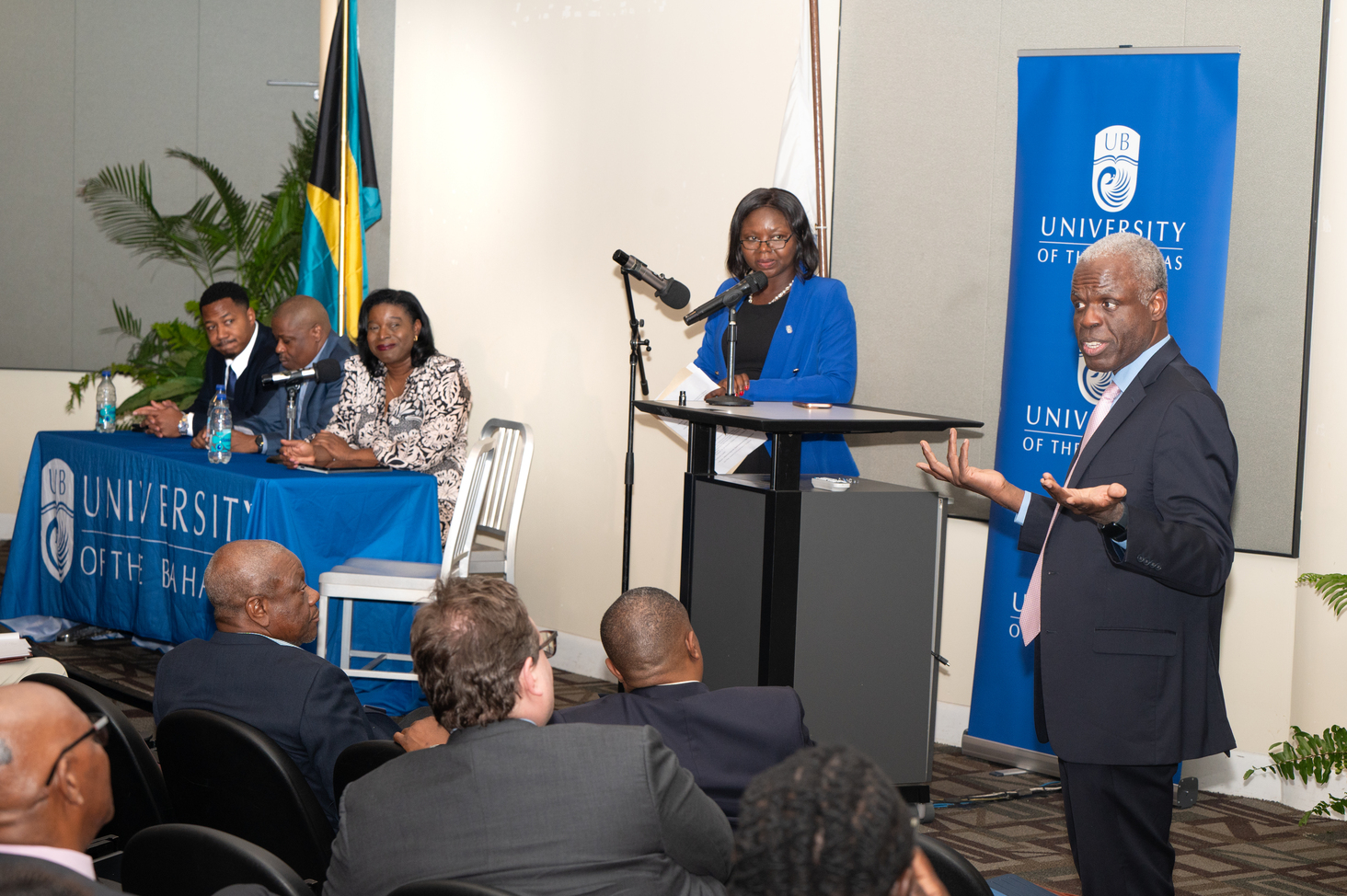
- Governor of The Central Bank of The Bahamas John Rolle makes a point during the panel discussion.
-
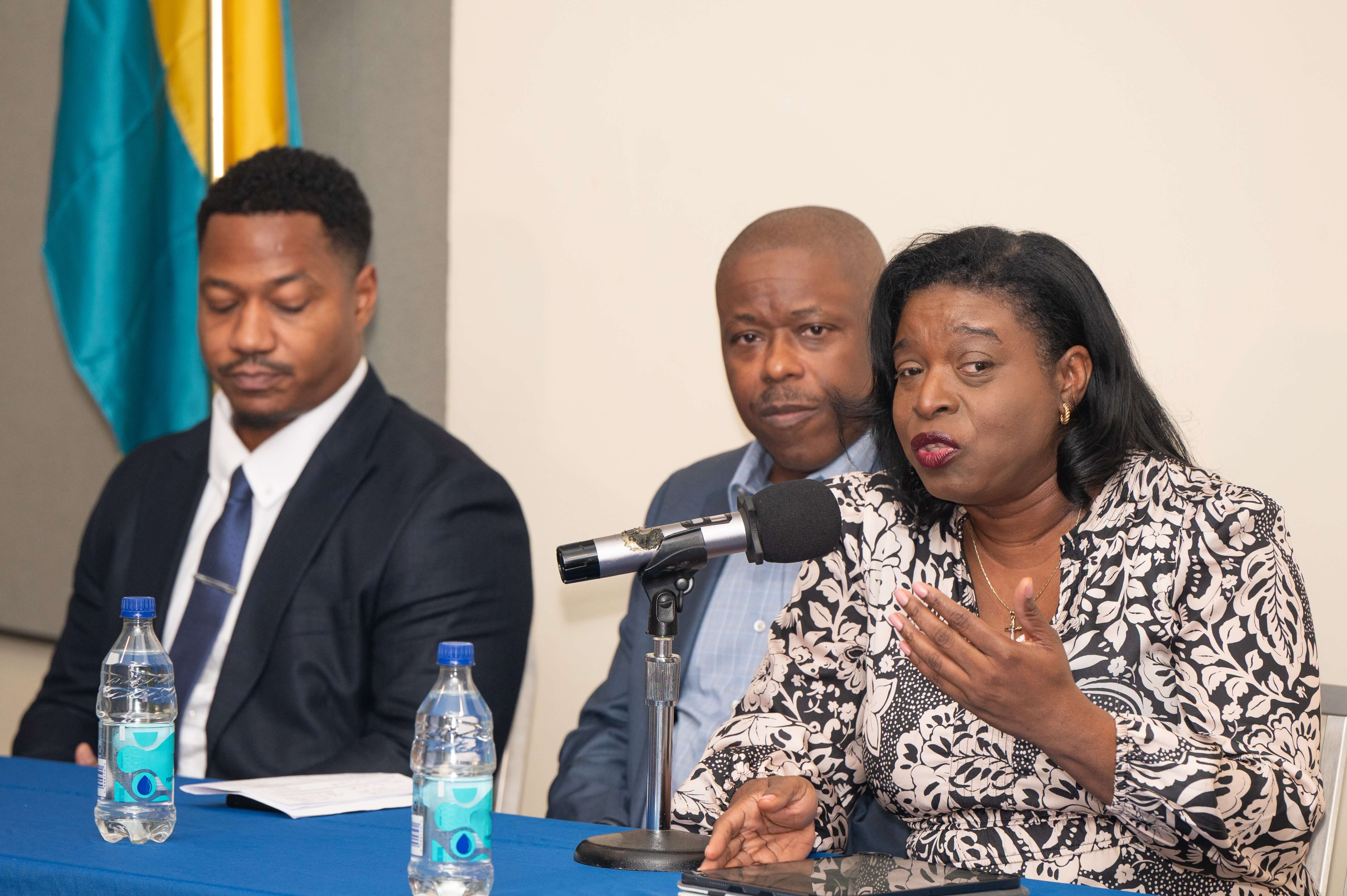
- At right, Christina Rolle, Executive Director of the Securities Commission of The Bahamas, explains part of The Bahamas’ regulatory regime.